
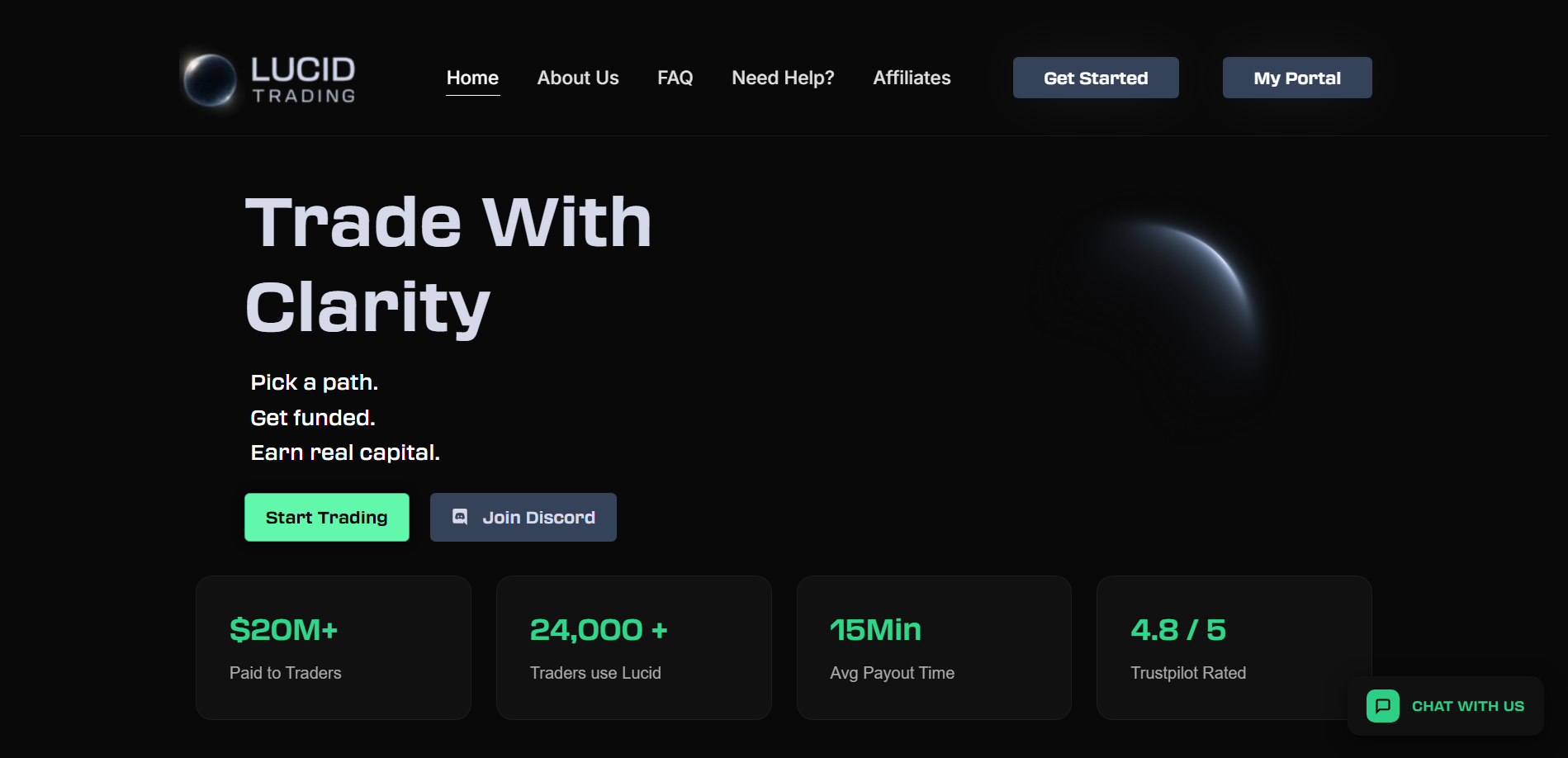
 Lucid Trading at a Glance
| Founded | 2024 |
| Headquarters | Not publicly disclosed |
| Specialization | Futures Prop Trading |
| Account Models | Evaluation & Direct Funded |
| Account Sizes | $50K – $150K |
| Pricing Model | One-time fee (no subscriptions) |
| Profit Split | Up to ~90% to trader |
| Payout Eligibility | After minimum profit & trading day rules |
| Drawdown Type | End-of-day drawdown |
| Intraday Loss Limit | None on select funded accounts |
| Trading Platforms | Third-party futures platforms |
| Best For | Experienced, self-directed futures traders |
Lucid Trading is designed for futures traders who prefer a simple, one-time fee model with fast access to funded accounts and flexible end-of-day risk management.

Lucid Trading is a futures proprietary trading firm that offers a variety of funded account solutions through a one-time payment structure. Instead of monthly subscriptions or tiered evaluations with multiple phases, Lucid emphasizes simplicity and speed — providing traders with direct or evaluation-based funded accounts and relatively flexible risk conditions. Its pricing model, clear payout cadence, and multiple account programs have attracted a broad cross-section of futures traders, but it also exposes Lucid’s limitations compared with more established competitors.
This review explains how Lucid operates, the differences between its account types, its pricing framework, and who is most likely to benefit.
Lucid Trading’s approach differs from traditional prop firms in that it avoids recurring subscription fees. Instead, traders pay a one-time fee to access funded accounts, either through evaluation accounts or direct funded access. Once funded, traders are eligible to receive profit share payouts once they meet profitability and minimum trading conditions.
Traders must comply with the firm’s risk parameters, including specific drawdown limits, performance consistency requirements during evaluation, and maximum contract exposures.
Lucid’s model is designed to attract traders who value transparency in costs, minimal bureaucratic hurdles, and a rapid path into funded trading.
 Lucid Trading Account Programs
Lucid offers several distinct account types, each with its own pricing and rule structure. Understanding how each works helps traders choose the most appropriate path.
|
|
|
|
Each Lucid Trading account type carries its own profit split structure and risk rules. Traders are encouraged to carefully review all conditions before selecting the program that best matches their experience level and trading objectives.
Risk management is a central aspect of Lucid Trading. Core rules focus on:
Lucid’s use of end-of-day drawdowns means a trader’s performance is assessed once the market closes, rather than penalizing intraday volatility as long as the account stays above thresholds at the close.
Direct funded accounts may have more stringent controls to offset the absence of an evaluation. Violations of risk rules typically result in account termination without refund.
Lucid’s pricing is based on one-off payments that cover access to evaluation or funded accounts. There are no ongoing subscription fees, and once an account is purchased and passed (where applicable), there are no additional charges to maintain funded status.
 Lucid Trading Pricing Table
| Account Program | Account Size | Starting Price |
|---|---|---|
| LucidTest Evaluation | $50,000 | $89.95 |
| LucidFlex Funded | $50,000 | $199 |
| LucidFlex Funded | $100,000 | $299 |
| LucidFlex Funded | $150,000 | $399 |
| LucidBlack Funded | $100,000 | $499 |
| LucidBlack Funded | $150,000 | $699 |
| LucidDirect Funded | $50,000 | $495 |
| LucidDirect Funded | $100,000 | $995 |
| LucidDirect Funded | $150,000 | $1,495 |
Prices are based on publicly displayed tiers and represent typical entry points. Because Lucid Trading pricing is shown dynamically during checkout, traders should always confirm current rates before purchasing.
Once a trader’s account becomes funded, Lucid allocates profit splits that are generally favorable, allowing the trader to retain the majority of net gains. The specific profit share percentages vary by program but often allow traders to keep around ninety percent of net profits after payout requirements are met.
Traders are required to meet minimum trading day counts and minimum profit levels before they can request withdrawals. Many traders report quick processing of payouts once eligibility criteria are satisfied.
Lucid supports industry-standard futures trading platforms that connect to live market data feeds. This means traders do not have to adapt to proprietary software but can use familiar interfaces they already prefer.
Since execution quality and data reliability depend on external platform providers, traders should ensure they are comfortable with their own setup before purchasing an account.
Lucid’s support team is frequently described by independent users as responsive and informative when it comes to rule clarification, account issues, and payout questions.
However, Lucid does not provide extensive training, coaching, or structured educational content. Traders who need strategy instruction or mentoring will likely need to source educational support externally.
Despite its newer entry relative to legacy prop firms, Lucid has built a recognizable presence in the futures prop space. Many traders report positive experiences with payouts and rule communication, though the firm’s shorter track record means it lacks the multi-year payout histories of larger competitors.
Independent feedback often commends Lucid for its pricing model and payout frequency, but some traders note that pricing transparency could improve, as account costs are best understood only during checkout.
 Pros &
  Cons of Lucid Trading
|
|
 Ideal Traders for Lucid Trading
|
|
Lucid Trading offers a straightforward and streamlined way for futures traders to access funded capital without the friction associated with subscription models or multi-stage evaluations. Its one-time fee structure and multiple account types provide flexibility, while strong profit share terms and fast payout access appeal to self-directed traders.
While Lucid’s shorter track record and pricing visibility could be improved, it remains a viable option for experienced traders seeking simplicity and speed. Prospective participants should carefully review risk rules and confirm current prices during the checkout process.
 LucidTest (Evaluation)
 LucidFlex (Funded)
 LucidBlack (Premium)
 LucidDirect (Instant Funded)
 Pros
Pros One-time payment model without subscriptions
 Direct funded accounts available
 High profit share after funding (~90%)
 End-of-day drawdown allows intraday flexibility
 Responsive customer support reported by users
 Cons
Cons Pricing must be verified at purchase — no centralized static list
 Newer firm with a shorter track record
 Limited educational resources
 Direct funded accounts require higher upfront costs
 Some risk rules require careful review before trading
 Well-Suited Traders
 Traders with a defined strategy and market experience
 Prefer a one-time payment over recurring subscriptions
 Want a fast path to funded trading
 Value frequent payout access once eligible
 Less Appropriate Traders
 Traders who need structured education or coaching
 New traders with no prior prop trading experience
 Prefer subscription billing or tiered discount structures
 Want long historical proof of pricing and rule consistency